Why Self-Defence Techniques Fail Under Stress (and What Shows Up Instead)
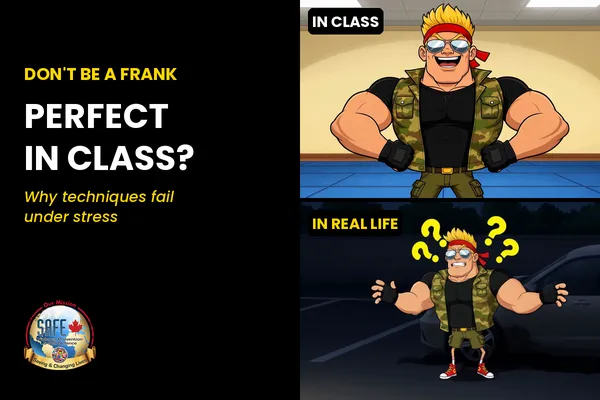
Frank's combo looks perfect in class.
His partner attacks slowly. Frank reacts with the technique he's practised thousands of times, the same way every time. He grins. He feels unstoppable.
Then real life shows up. Fast. Loud. No script.
Frank can't remember a thing.
Frank is a cartoon. But I've watched this happen to real people for more than 30 years.
Why Choreographed Techniques Fall Apart Under Stress
Choreography trains a sequence. Attack A has 6 memorized techniques in a set order.
Real life doesn't follow the sequence.
The attack comes from a different angle.
It's faster than anything in class.
There's noise, fear and no time to think.
When the attack doesn't match the drill, panic sets in. That's why so many students freeze. They're searching for step one of a routine that no longer meets the reality of the moment.
Under stress, you don't rise to the occasion. You fall back on what you remember.
Flashy training that looks cool, but collapses when it counts.
There's No "Perfect" in Self-Defence
I've watched courses where students practise a technique, and the instructor stops them again and again to fix a tiny detail. A hand a little too low. A foot a few inches off.
The goal becomes a perfect technique.
But there's no perfect in self-defence. Success isn't a clean technique. Success is surviving and getting home safely.
When we chase perfection in class, we teach students that anything less is failure. Then, under stress, when nothing goes perfectly, survival chances drop.
What Actually Shows Up: Principles and Concepts
What shows up under stress is what's been drilled under some pressure, using principles and concepts, not memorized sequences:
A few simple, effective moves, not fifty
Practised against a partner who doesn't give you a false sense of confidence by reacting the way you expect
Based on principles you can adapt, not steps you have to recall in order
Simple skills. Strong instincts. That's what shows up under stress.
A Story I Still Think About
Years ago, I got an email from a woman who took our course as a teen. More than 14 years had passed since her class.
She didn't start with the attack. She started by telling me what she remembered from the prevention part of the course. I joked that her recollection was better than what I taught.
Then she told me why she was writing.
Her boyfriend attacked her. It wasn't an attack we had covered in class.
She didn't remember a specific technique. She remembered the principles and concepts. She used them, she survived, and he was charged.
Two things still stay with me:
Prevention was what she remembered most, more than 14 years later.
When the physical part came, she didn't need the perfect move. She needed something she could remember and adapt when it mattered.
Stop Stopping: Problem Solve in Training
I don't find choreography helpful. Here's what works better.
Students practise a few possible defences. But when something doesn't go as planned in practice, we don't stop. We problem-solve.
I don't like calling it a mistake, because that's when the real learning happens. In real life, you can't force the move you learned. So in training, we ask:
You're two steps back. Can you run?
Should you step in and keep going until you can get away?
You got knocked back. Can you adjust and keep moving?
Every "mistake" in training is a chance to practise what to do when things go wrong. And under stress, things will go wrong.
Don't aim for perfection. Aim for survival and getting home.
The Honest Truth
I wish I could promise that everything we teach will be remembered when it matters. No one can promise that.
What I can tell you is this: simpler, more realistic defences, based on principles and practised under some pressure, give people the best chance of remembering.
Don’t seek perfection in your training; seek the ability to recall it.
What This Means If You Teach Self-Defence
Three changes you can make in your next class:
Cut the number of techniques. Teach fewer, and practise them more with variations.
Stop stopping for small details. Let students work through it, then debrief.
Change the attack. Vary the angle, speed and pressure so students learn to adapt, not repeat.
This is how we train instructors in the SAFE self-defence instructor certification: prevention first, simple skills people can recall, and training built for real life, not the demo.
Ready to see what's inside, including pricing and the VIP starting option? See the SAFE Certification details here.
Want to see how we build pressure in steps? Read Pressure Testing in Self-Defence: Why "Full Power or It's Useless" Breaks Beginners.
Frequently Asked Questions
Why do self-defence techniques fail under stress?
Most are trained as fixed sequences against slow, predictable attacks. Real attacks are fast and messy. When the attack doesn't match the drill, students often freeze trying to recall the "right" move.
Is choreographed self-defence training useless?
It can teach basic movement. But on its own, it rarely prepares people for real stress. Training needs to add variation, some pressure and problem-solving.
What do people actually remember in a real attack?
Usually simple ideas and principles, not long combinations. That's why fewer, simpler skills tied to clear decisions tend to hold up better.
How can I learn to teach realistic self-defence?
The SAFE self-defence certification shows instructors how to teach prevention first and build simple skills people can recall under stress.
Prevention-First Self-Defence
Simple to Remember. Built for Stress.
Keep SAFE
Chris Roberts


