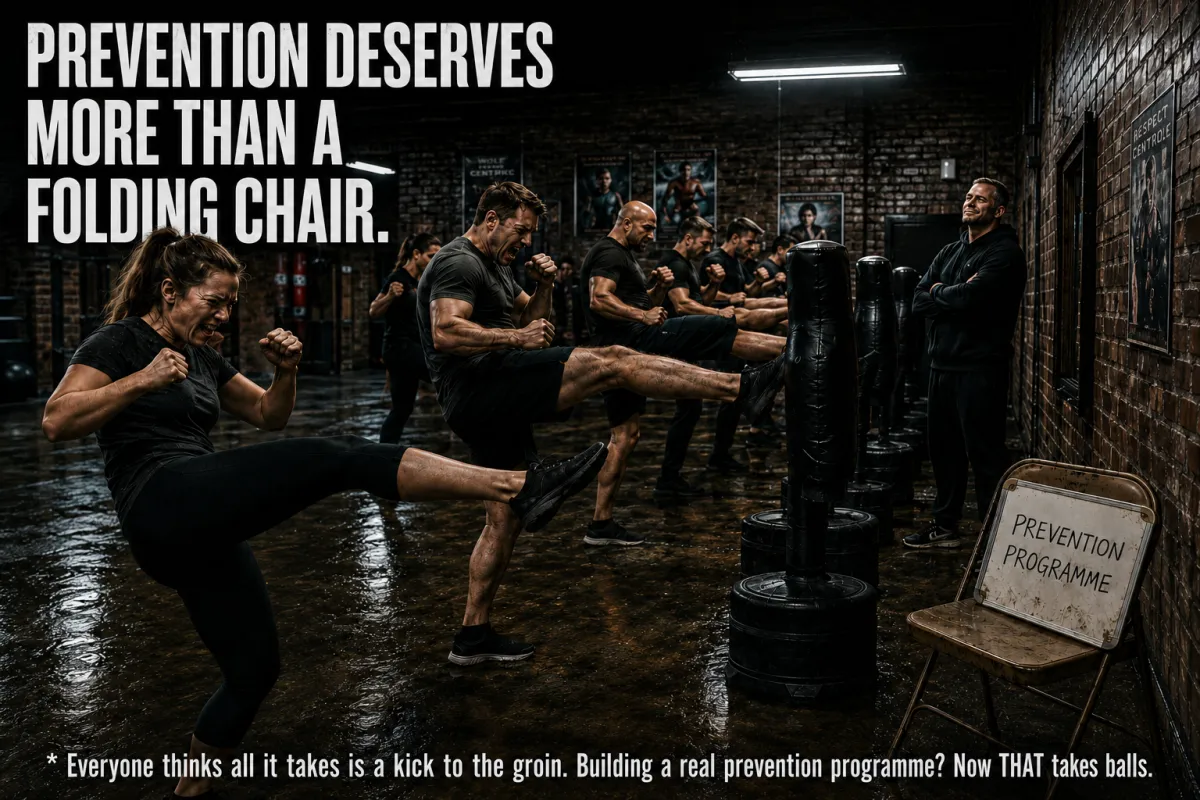
10 Minutes of Prevention Beats a Kick to the Groin
Most self-defence instructor training buries prevention under physical drills. Here's what that costs your students.
You know how it goes.
Class starts. There's a quick chat about awareness. Maybe boundaries. Possibly a story about staying alert in parking lots.
Ten minutes. Maybe fifteen if you're generous.
Then the pads come out.
And prevention never comes back.
That's not teaching self-defence. That is teaching how to fight.
Most self-defence classes follow the same pattern.
Short course or ongoing weekly classes. Doesn't matter.
Prevention briefly gets discussed, if at all. Then the real class starts.
Kicks. Punches. Wrist grabs. Choke defences. Groundwork.
The physical takes over and stays there.
And most instructors genuinely believe they're teaching self-defence.
They're not.
They're teaching fighting.
There's a difference. And it matters.
Fighting is what happens when prevention has already failed.
Most of the time.
Yes, sometimes an attack is immediate—an ambush. No warning. No time to think.
But those situations are the exception. Not the rule.
In most cases, there are precursors. Variables. Early signals that something is developing.
Self-defence starts long before anyone throws a punch.
And there is nothing wrong with teaching people how to fight.
Nothing at all.
Just call it what it is.
Fighting.
Not self-defence.
But here's what most instructors miss, even when they do teach physical skills.
Where are the psychological variables?
The emotional ones?
Your relationship to the person attacking you?
What happens to the body under real fear?
How does hesitation affect timing?
What does doubt do to someone mid-technique?
If you teach physical skills without those, you don't have self-defence training.
You have choreography.
Choreography that may work perfectly in a gym with a willing partner.
And collapse completely when it counts.
The psychological and emotional variables don't just add to physical skills.
They make them work.
Or they prevent them from working entirely.
That's the difference between fighting and self-defence.
And most programmes never teach it.
It gets worse for ongoing classes.
At least a short course has an excuse.
Limited time. Cover the basics. Move on.
But ongoing classes have no excuse.
Week one might include some prevention talk.
By month three, it's all technique.
By year one, your students can execute twenty drills and still can't tell you how to read an approach before it escalates.
Prevention didn't just take a backseat.
The seat is gone.
What self-defence instructor training often gets wrong.
Some instructors will say you can't learn self-defence in a few hours.
They're not wrong for their students.
The ones who come back week after week. Month after month. Who build on last week's drill and refine it this week.
But that's not who most people are.
The average person who ever seeks any violence prevention or self-defence training will do it once.
One session. Maybe two.
And here's what most instructors miss.
Twenty seconds of the right instruction can save a life.
Not 289 techniques.
Not a full curriculum built for the dedicated student.
Twenty seconds of simple, practical, memorable information taught to someone who may never come back.
That's the standard worth building around.
Not what impresses the regulars.
What sticks with the person you'll never see again.
Five words.
We taught a session at a school some years ago.
One of the SAFE instructors, Pamela Armitage (an amazing instructor) worked with a class of teenage girls that day.
Part of what we taught was a mindset anchor.
Simple. Practical. Easy to remember under stress.
Get home to my family.
Five words.
Not a technique. Not a drill. Not a combination.
A reason.
Some time later that teenage girl was attacked by her aunt's partner.
He had fighting skills. He was stronger. More physically capable.
He killed her aunt.
She survived.
During the attack, she kept repeating those five words over and over.
Get home to my family.
The following year when we returned to her school she asked to speak to the students herself.
She wanted them to know how important that training was.
We do not take credit for her survival.
We never do.
We provided the education.
We hoped she would never need it.
We hoped that when she did it was impactful enough.
She made it home.
The student nobody talks about.
Some students will never get comfortable with the physical side.
Past experiences. Anxiety. Physical limitations. Doubt.
They show up anyway because they want to feel safer.
With students like that we don't push harder toward physical.
We go deeper into prevention.
More discussion. More awareness. More decision-making.
And we ask them a different question.
If you did not defend yourself, what could you lose?
Time with your family. Your children. Friends. A job you love. A life you've built.
Something shifts when people sit with that question.
You can see it in their face. Their posture. Their body language.
And when they return to the physical drills their effort dramatically increases.
Because now it's not about technique.
It's about what they're fighting for.
That's self-defence.
Search self-defence online.
Go ahead. Any platform.
Count how many videos are purely physical.
Kicks. Wrist releases. Choke escapes. Ground defence.
Now count the prevention content.
The awareness skills. The conflict resolution. The psychological preparation.
The gap tells you everything about where the industry's priorities are.
Most instructors don't prioritize prevention.
Some don't know how to make it engaging.
Others simply don't have enough knowledge of the topic to teach it well.
And prevention content doesn't get the views that a flying knee does.
So it gets skipped.
And students keep leaving programmes knowing how to kick but not knowing how to think.
Prevention first doesn't mean physical never.
Physical skills have a place.
Nobody at SAFE is saying don't teach them.
But they belong at the end of a foundation. Not as the foundation itself.
When prevention is woven into every class, not just the first ten minutes, something changes.
Students start making better decisions earlier.
They spot problems before they develop.
They leave situations before physical becomes necessary.
That's the outcome self-defence training should produce.
Not a student who can execute 289 techniques on a compliant partner in a controlled gym.
One question worth asking yourself.
If a student came to you once and never came back, what would they leave with?
Awareness skills they could use tomorrow?
Or half-learned drills they'll forget under stress?
That answer tells you everything about what your programme is actually built around.
We've written more about what real success looks like for a self-defence instructor.
If this post made you think, that one will too.
If this post made you think about how your programme is structured, that's worth exploring further.
Take the free instructor audit at safeinternational.biz/instructor-audit
Keep SAFE.
Chris Roberts SAFE International


