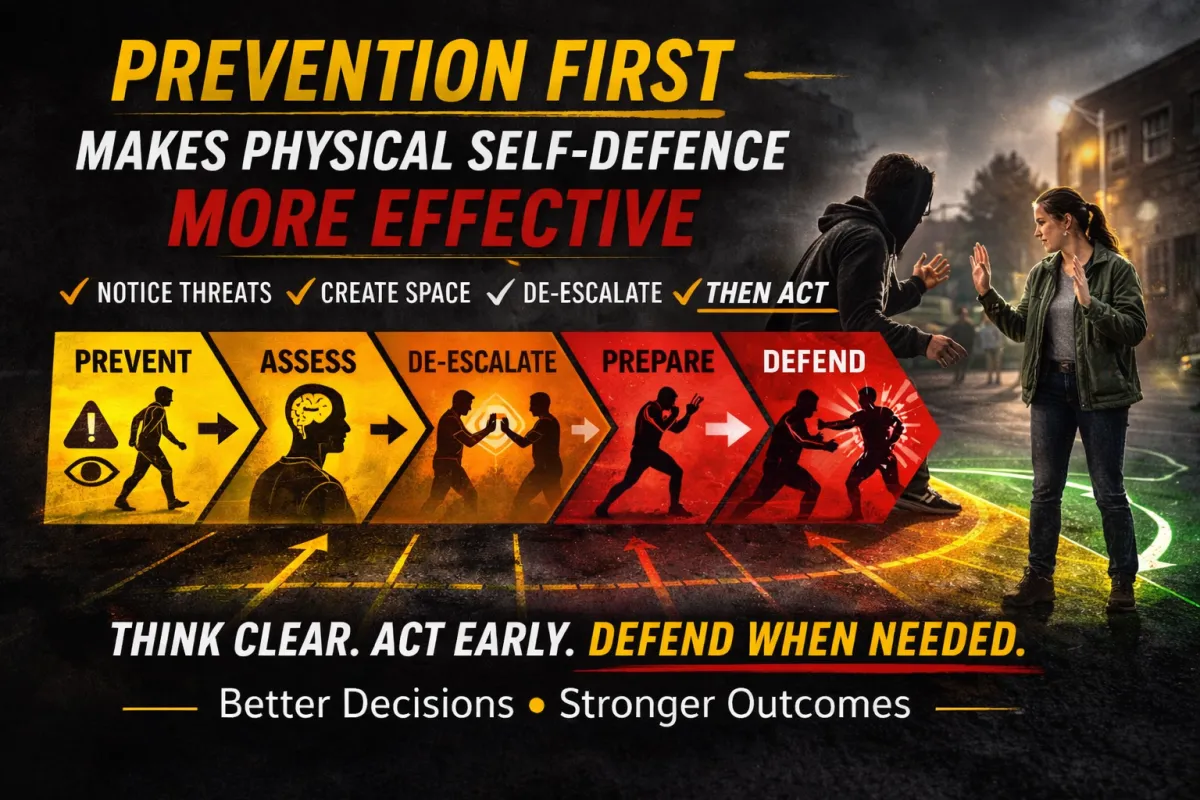
Why Teaching Prevention First Makes Physical Self-Defence More Effective
In many self-defence circles, it is not uncommon for instructors to teach, hit first and ask questions later. The idea is simple: if something appears wrong, act fast and worry about the consequences later. Some even repeat lines like “I’d rather be judged by 12 than carried by 6.” It sounds tough. It sounds decisive. But when you look more closely, it lacks deeper insights which any credible self defence certification will address.
The issue isn’t that physical force is never needed—sometimes it is, and if one is ambushed, it should be one's automatic response. The real problem comes when people are taught to use force too soon or when they lack other options in their training. If that’s the first response one has been taught to use in dealing with a conflict, people often react emotionally rather than with clear thinking. They could hit when it wasn’t necessary, miss a chance to walk away, or even make things worse.
Putting prevention first doesn’t make someone weak. It actually helps people be more aware and ready. It teaches them to notice trouble early, keep a safe distance, read others’ actions, use conflict resolution skills, and move to safety before things get out of hand. These aren’t just soft skills—they’re practical and critical tools for making better choices when it matters most.
This matters because stress affects how we think. The American Psychological Association notes that stress can affect how people think, feel, and act, which is exactly why decision-making often worsens under pressure. Criminal Code
That’s why having simple, memorable choices is so important. In stressful moments, you don’t suddenly perform better—you rely on what you remember.
When people learn prevention first, they have a clearer plan. If those steps don’t work and the threat keeps growing, the choice to use force is usually much clearer. There’s less confusion, less hesitation, and less uncertainty.
This is a major mistake in poor self-defence training—it frequently starts with the fight itself. In real life, things usually start much earlier, with discomfort, uncertainty, odd behaviour, bad positioning, or someone crossing boundaries. If people only train, or if training is primarily focused on fighting back, they might miss all the warning signs that come before it.
Teaching prevention first also gets people to consider things that are often overlooked. There could be witnesses, cameras, legal issues afterward, or emotional effects that last long after the event. That’s why it’s usually smarter to react with a plan instead of acting right away. Physical force shouldn’t be the first choice just because someone feels uncomfortable or unsure.
A better self-defence approach stops people from treating every tense moment as a reason to fight. Instead, it helps them understand what’s happening and stay calm as much as they can. If they do need to defend themselves, they’ll know the reason for their actions, not just that they’re reacting.
That is the real value of teaching prevention first. It does not remove physical self-defence. It puts it in the right place. It makes the decision to act clearer, more thoughtful, and often easier to justify. That is not a weakness; in fact, it is a demonstration of true confidence and good judgment, gained through valuable training.
Prevention first does not make physical self-defence less important. It makes it clearer, more responsible, and more effective when needed.
Keep SAFE!
Chris Roberts, Founder SAFE International Self Defence


