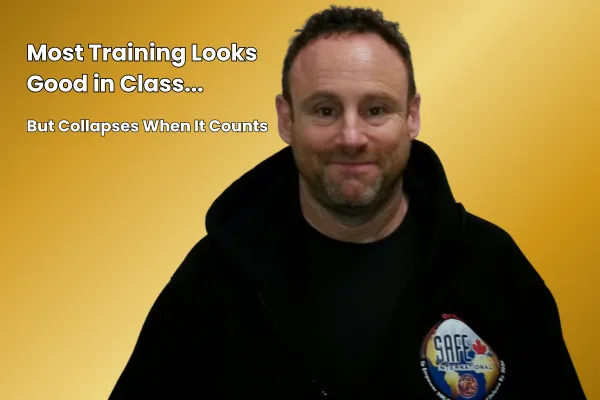
Why Most Self-Defence Training Fails Regular People
Most self-defence training is built for the wrong person.
It's designed for someone who trains regularly, handles pressure well, and can remember a long sequence of moves when fear hits.
That's not most people.
Most people take one class. Maybe two. They're nervous, distracted, and completely unprepared for how differently their brain works under real stress.
And yet most self-defence programs teach them the same way they'd teach a dedicated martial artist.
That's the problem.
What Happens to the Body Under Stress
When real danger hits, the body does predictable things.
Heart rate spikes. Fine motor skills deteriorate. Tunnel vision kicks in. Complex decision-making slows way down.
This is not a character flaw. It's biology.
The problem is that most self-defence training ignores this completely.
Instructors demonstrate impressive techniques in a calm gym, with a cooperative partner, at a controlled pace. Students copy the moves, feel confident in class, and leave thinking they're prepared.
They're not.
Under stress, you don't rise to the occasion. You fall to what you can remember.
If the training didn't build recall under stress, the training didn't work.
The Technique Overload Problem
More technique does not mean more safety.
It often means the opposite.
When someone is overwhelmed with options under pressure, they freeze. Too many choices slow decisions. Slow decisions in dangerous situations cost people dearly.
The self-defence programs that fail regular people share a common pattern:
Long lists of techniques for every scenario
Complex sequences that require perfect timing
Training that assumes physical strength and athleticism
No focus on prevention or early decision-making
No attention to what students will actually remember six months later
This is what we call flashy training. It looks good in class. It collapses when it counts.
What Regular People Actually Need
Regular people don't need a hundred techniques.
They need a few clear decisions they can actually make when stress hits.
They need to know:
How to spot problems early before they escalate
How to use words, distance, and boundaries to reduce risk
How to make a fast decision when options narrow
How to respond physically in the simplest possible way if there's no other choice
That's it.
Prevention first. Conflict skills second. Simple physical response only when necessary.
The fewer things a person has to remember, the more likely they are to remember them.
The Problem With Vague Advice
On the other end of the spectrum is the other failure mode.
Vague advice.
"Be aware of your surroundings." "Trust your gut." "Don't walk alone at night."
These things aren't wrong. But they're not training. They're suggestions.
Real self-defence training teaches people specifically what awareness looks like. What to do when the gut feeling hits. How to respond when a situation starts to shift.
Vague advice gives people a false sense of preparation without the actual skills to back it up.
Both extremes fail regular people. Too much technique overloads them. Too little leaves them with nothing usable.
The answer is somewhere simple and clear in the middle.
What Good Self-Defence Training Looks Like
Good self-defence training for regular people is built around recall under stress.
It asks: what will this person actually remember and use when pressure hits?
That means:
Simple frameworks, not long technique lists
Prevention taught as a skill, not just an idea
Conflict resolution that works without perfect confidence
Physical options that don't require strength, speed, or athletic ability
Repeated reinforcement of the few things that matter most
It also means teaching people who may only ever take one class. Not assuming they'll train every week for years.
That's a different kind of program. And most certifications don't teach instructors to build it.
Why This Matters for Instructors
If you teach self-defence, this is worth sitting with.
Are you teaching for performance or for recall?
Are your students leaving with a long list of techniques or a short list of decisions they can actually make?
The goal isn't to impress people in class. The goal is for something to still be there six months later when they need it.
That's what SAFE is built around. A simple framework that instructors can teach clearly, and students can actually use.
If you want to teach self-defence that holds up under real stress, explore the SAFE self-defence instructor certification and see whether our prevention-first approach fits how you want to teach.
Frequently Asked Questions
Why does self-defence training fail under stress? Most training is built for calm, cooperative conditions. Under real stress the brain works differently. Complex techniques become hard to recall. Simple, well-practised decisions are far more reliable.
What self-defence skills do regular people actually need? Regular people need awareness skills, simple conflict resolution tools, and a small number of physical responses that don't rely on perfect timing or athletic ability. Prevention first. Physical response last.
How is SAFE different from other self-defence programs? SAFE is built around recall under stress. The framework is simple, the focus is prevention first, and the teaching is designed for regular people who may only train once. No technique overload. No flashy moves that collapse under pressure.
What makes self-defence training practical? Practical training focuses on what students will actually remember and use under stress. That means fewer techniques, clearer decisions, and a focus on prevention and conflict resolution before physical response.
Keep SAFE!
Chris Roberts
www.safeinternational.biz


