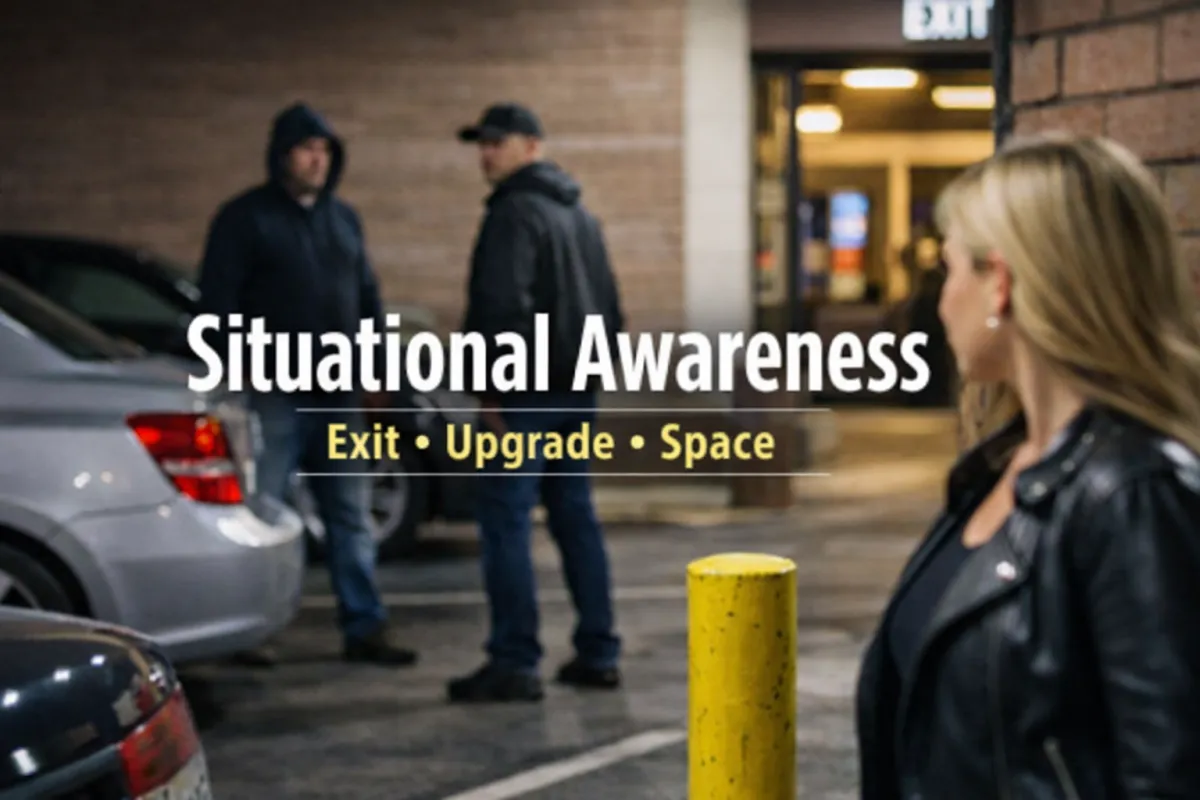
Situational Awareness Under Stress: The Reposition Rule
Exit • Upgrade spot • Space — because stress doesn’t make people smarter.
Situational awareness is not about scanning randomly — it’s about repositioning early when something feels off.
Why “be aware of your surroundings” is weak advice
It’s vague.
Aware of what, exactly?
People default to scanning randomly, then missing what matters.
It creates false confidence.
“I looked around” feels like action.
But nothing changed in your position, distance, or exit options.
Stress makes decision-making harder.
You don’t need more “tips.”
You need one simple rule you can remember.
The Reposition Rule (simple, real, repeatable)
Rule: If something feels off, don’t debate it. Reposition.
This is not panic.
This is a quiet upgrade that buys you time and options.
Quick scan:
Exit • Upgrade spot • Space
Step 1 — Exit (if you can leave, leave)
If you can leave safely, do it.
You are not “overreacting” by choosing distance.
Simple examples:
You’re outside a store and someone is hanging around too close → go back inside
You’re on transit and someone is tracking your movement → move cars / get off where there are people
You’re in a parking lot and someone closes distance → go back to well-lit areas or into a business
Step 2 — Upgrade your position (if you can’t leave yet)
If you can’t leave immediately, change the chessboard.
Upgrade your position to get:
more light
more space
more eyes (witnesses / staff / cameras)
a cleaner exit path
Practical upgrades:
Move toward staff, not deeper into aisles
Choose open space over corners or tight hallways
Put a solid object between you and the person (counter, car, bench)
Avoid getting boxed in (elevators, stairwells, narrow paths) if you have options
Step 3 — Create space (space buys time)
Space gives you:
more time to think
more time to move
more time to speak clearly
Space also reduces surprise.
If someone keeps closing distance after you reposition, that’s useful information.
What “feels off” can look like (simple cues)
Not “mind reading.” Just patterns that deserve action.
Examples:
Someone closes distance without a clear reason
Someone mirrors your movement
Someone blocks your path or drifts into your lane
Someone lingers near your car, exits, or tight spaces
Someone’s attention feels sticky (watching, tracking, circling)
The point:
You don’t need to prove danger.
You need to protect options early.
Real-world examples (where this matters most)
Parking lot safety
Exit: go back inside
Upgrade spot: move near entrances, lights, people
Space: keep distance while unlocking/entering vehicle
Public transit safety
Exit: get off where there are people
Upgrade spot: move near driver / busy areas
Space: change cars or seats early
ATMs and store lines
Exit: stop the transaction
Upgrade spot: step aside to staff/cameras
Space: create distance before you’re boxed in
Common mistakes that get people stuck
Debating your intuition.
“Maybe I’m being paranoid.”
“Maybe I’m misreading this.”
Waiting for certainty.
Safety decisions often happen before certainty.
Moving deeper into isolation.
Back stairwells, quiet hallways, dark corners, empty lots.
Technique overload.
Too many “moves” and not enough simple decision rules.
Next Step
If you want self-defence built around recall under stress (not cinematic technique overload):
Visit SAFE International Self-Defence Certification SAFE Certification | Self-Defence Instructor Certification
Explore training for regular people Self-Defence Courses in Ontario | Women, Teens & Corporate
Browse instructor resources Instructor Hub | Self-Defence Instructor Certification & Training
Keep SAFE!
Chris Roberts
Founder, SAFE Violence Prevention & Self Defence
www.safeinternational.biz


