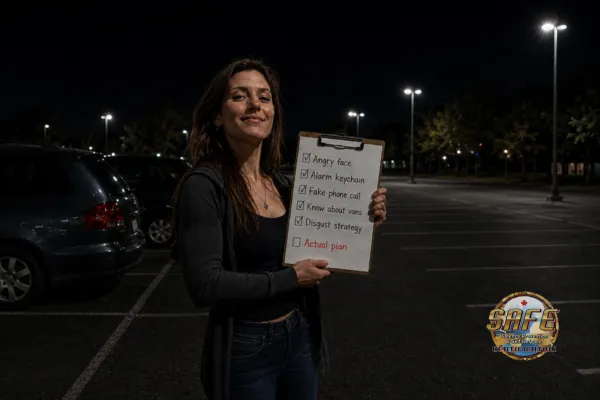
5 Self-Defence Tips for Women That Feel Safe — But Aren't
You've probably heard most of these.
Maybe you've even agreed with some of them.
They sound reasonable to many people, and I have had countless clients and instructors ask for my opinion on them.
But when you actually think them through, they leave you more vulnerable than you realize.
Most are shared by people who genuinely want to help.
But good intentions don't make bad advice effective when you dive deeper into the details.
Here are five tips that sound smart on the surface — and fall apart when it counts.
Tip 1: Make Yourself Look Disgusting
This one actually appeared on an official university safety list.
The University of Colorado at Colorado Springs advised female students that urinating, defecating, or vomiting might convince an attacker to leave them alone.
The list also suggested telling your attacker you have a disease. Or that you're menstruating. Or faking a seizure.
The backlash was immediate. The list was taken down within 24 hours and replaced with an apology.
You can read the original CNN story here: CNN — Colorado College Advises Students to Urinate, Vomit to Stop Rapists
Here's the problem with all of these.
They assume your attacker is rational.
A determined predator is none of those things.
And trying to fake a convulsion or vomit on command under real stress — while your body is flooded with adrenaline — is not a skill most people have.
There is no evidence that these techniques reliably stop an attack. In many instances, it could actually escalate the attack even more. I often ask people to discuss or discuss and consider any advice well beyond the one single statement of advice given.
Tip 2: Walk Around With an Angry Face to Keep People Away
I often ask women if they smile, avoid or adjust their body language when they walk past men.
The thinking makes sense on the surface. Look unapproachable. Men will leave you alone.
But first, how sad is it that anyone has to think about whether they should smile, not smile, or make eye contact with someone?
But it misses something important.
An angry expression reads very differently from a confident one. It is challenging or commanding.
Confidence says: I am aware. I am calm. I know what is around me.
Anger says: I am emotional. I am reactive. I am already unsettled.
Those are two completely different signals.
Predators don't look for people who seem angry. They look for people who seem distracted, unsure, or emotionally off-balance.
An angry face can read as someone faking confidence, which is closer to appearing vulnerable than confident. Can the advice work? Sure, anything can work, but that does not mean it should be your sole strategy.
The goal is calm awareness. Not a pissed-off expression.
Those are not the same thing.
Tip 3: Fake a Phone Call So You Look Less Alone
This one is passed around constantly, and I hear it all the time.
The idea is that if an attacker thinks someone knows where you are, they'll leave you alone.
Three problems.
Problem 1 — They can't tell it's fake.
But they can tell you're distracted. Head slightly down. Focused on maintaining a conversation. Not scanning your environment.
A fake call doesn't make you look protected. It makes you look distracted even if you are not. That's a different thing entirely.
Problem 2 — Even a real call doesn't help you.
Your friend is somewhere else. They can't reach you in time. Do they know your exact address? The name of the street you're on? How long will it take for help to arrive?
Problem 3 — You trade real awareness for the feeling of it.
The one tool that actually helps — your own attention — gets switched off the moment the phone goes to your ear.
A fake phone call doesn't fool the attacker. I also have many tell me, but if attacked, they could surprise their attacker because they aren't distracted. My answer is always, "But aren't you better off avoiding an attack to begin with by appearing aware?"
It just fools you into thinking you're safer than you are.
Tip 4: Just Carry Pepper Spray or an Alarm
I have posted about this endlessly over the years. Let's be clear about something first.
Pepper spray and personal alarms are not useless.
In the right situation, used correctly, they can absolutely help.
But here's what the person who sold it to you probably didn't mention.
Under real stress, your fine motor skills break down. Finding a canister of pepper spray or alarm in a bag, removing a safety cap, and aiming accurately while your hands are shaking is much harder than it sounds in a calm moment.
Personal alarms require someone to be close enough to hear them. On an empty street at midnight, nobody is coming. And in a house where you are isolated will do little to help.
The gadget isn't the problem.
Believing the gadget is the plan — that's the problem.
There are no shortcuts to safety. These devices, as an add-on to high-quality instruction on how to avoid violence, can have some value, but not in place of.
The person who sold it to you wasn't an instructor. A good instructor would have taught you what to do before you ever needed it.
Tip 5: Watch Out for Vans Parked Next to Your Car
This one has been shared millions of times on social media, and recently came to my attention.
The advice — if a van is parked on the driver's side of your car, get in through the passenger side. Kidnappers target vans because they can pull you in quickly.
There is no verified source behind this. No documented cases. No evidence that it reflects how abductions actually happen.
It originated from a fabricated story that spread because it felt credible.
Here's what makes it more than just wrong — it's actively harmful.
It trains people to be hypervigilant, even paranoid, about an extremely rare scenario, while doing nothing to prepare them for the threats that are actually common.
Most violence doesn't happen in a parking lot with a stranger in a van, and with proper education, one can see the potential for harm from a distance, not attempt getting into their vehicle.
The threats you hear about most loudly are often the ones least likely to affect you.
That's not an accident. Fear sells. Prevention doesn't click as well.
So What Actually Works?
Not a single strategy. No self-defence gadget.
Understanding.
Knowing where danger actually comes from. Learning to read situations before they become problems. Making decisions early — when you still have options.
That's what keeps people safe.
Not the groin kick. Not the alarm keychain or pepper spray. Not yelling BACK OFF.
The decision you make before any of that becomes necessary.
That's what SAFE has been teaching since 1994.
Simple to Remember. Built for Stress. Not Performance.
Want to Learn What Actually Works?
Whether you're looking for practical personal safety knowledge or you want to teach it to others, SAFE has you covered.
Keep SAFE.
Chris Roberts SAFE International www.safeinternational.biz


