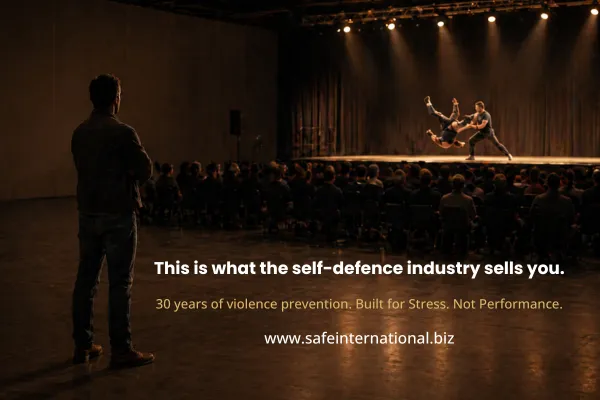
The Self-Defence Industry Has a Content Problem
I posted an image this week.
A woman kneeing a man in the groin in a dark alley.
Big text on the front: "Self Defence Tip #1: Knee Groin. Works EVERY TIME."
Fine print at the bottom: "Results not guaranteed. Side effects may include sterility, regret, soul leaving body."
I posted it as a joke.
But here's the thing.
That image is a near-perfect picture of what the self-defence industry has been selling to people for decades.
We Did This
I want to be clear about something.
When I say "we". I am sure I have been guilty as well, more in my early days of teaching.
We picked the dramatic scenarios. We sold the killer techniques. We built content around the rarest situations and called it complete.
A dark alley. A stranger. One perfect technique. Problem solved.
And this is why so many people believe self-defence is a back alley and a groin kick.
It's not.
Most violence happens at home. With someone familiar. With warning signs that appeared long before any punch was thrown.
And "knee to the groin works every time?"
No. It doesn't. Nothing does.
Teaching that it does is precisely how you find yourself needing the fine print disclaimer.
Why the Industry Keeps Doing It
I'm not going to name names or hold one specific instructor accountable.
The overwhelming majority got into it for the right reasons. They care. They have real skills. Many of them are genuinely excellent instructors.
But they are working inside a system that rewards the wrong things.
Flashy content gets clicks.
Complex techniques look impressive on camera.
Dramatic scenarios build followings fast.
So that's what gets made.
Week after week. Channel after channel. A steady stream of content showing regular people what self-defence looks like in action movies.
Not what it looks like in real life.
Not what it looks like for a regular person, under real stress, in a moment they didn't see coming.
The incentive is performance.
And the content follows the incentive.
What Regular People Actually Take Away
Here's where it gets costly.
Most people watching this content are not passionate about self-defence like you and I. They're not training three times a week. They're not building a skill set over years.
They are regular people trying to understand how to stay safe.
And what the content tells them — without ever saying it directly — is that self-defence starts when someone grabs you.
Not before that moment.
Not with the awareness, the decisions, the exits, the early signals.
Just the grab. And the counter.
So they watch. They feel informed. They feel ready.
And they walk away with a completely false picture of what actually keeps people safe.
That's the cost.
Not the instructors chasing clicks.
The students who believe what they are being shown.
What the Evidence Actually Shows
Violence prevention research is consistent on this.
The physical confrontation is almost always the last moment in a sequence — not the first.
Before the grab, there was a location.
Before the location, there was a decision.
Before that decision, there were signals — in the environment, in another person's behaviour, in a feeling that something wasn't right.
Most violence is not random.
Most situations have an approach phase.
Most people who are harmed have many cues — sometimes obvious — where a different decision could have changed everything, but without knowledge of them, they are never considered.
Training people to respond to the grab without training them to see what comes before it is like teaching someone to treat a wound without teaching them how to avoid the knife.
It's not useless.
But it's incomplete in a way that matters.
The Recall Problem Nobody Talks About
There's a second issue that gets almost no attention in online self-defence content.
Stress destroys performance.
Under real threat — not a drill, not a camera rolling — the body does things training often doesn't account for.
Heart rate spikes. Fine motor skills break down. Tunnel vision sets in. The brain scrambles for an answer.
What it finds is what you've practiced most, under conditions closest to what you're experiencing right now.
Most technique videos are practiced in controlled environments. With a cooperative partner. At a pace that allows for adjustment.
Real stress doesn't offer any of those conditions.
So the question that actually matters — the one almost nobody in online content asks — is not "does this technique work?"
It's "can a regular person recall and use this under real stress, without warning, in a situation they didn't see coming?"
For most of what gets posted online?
The honest answer is no.
Simple beats complicated every time under real pressure.
A clear decision made early beats a perfect technique made late.
Prevention beats response.
That's not an opinion. That's what the evidence consistently shows.
What This Means If You Teach Self-Defence
If you are a self-defence instructor — or thinking about becoming one — this is worth thinking about.
Your content is not just marketing.
It's education.
What you post shapes what your students believe self-defence is.
It shapes what they prioritize.
It shapes the decisions they make in moments that actually count.
An instructor who only posts physical technique content — even excellent, well-intentioned content — is telling their audience that self-defence starts at the grab.
That's a costly message to send.
The best instructors I know in this field understand that the physical component is the last resort — not the foundation.
That prevention is not an afterthought to real training.
It's the most important part of it.
They post accordingly.
They measure success not by how impressive their technique looks on camera, but by whether their students are making better decisions before anything physical ever happens.
That's harder to make a video about.
It's also the thing that actually keeps people safe.
What SAFE Is Committed To
I put physical videos up too.
Physical skills have a place in a complete self-defence curriculum.
But the foundation of everything SAFE teaches is this:
Prevention is the priority.
Awareness. Decision-making. Early signals. Exits. Boundaries.
The goal is never to have a great story about how you handled a dangerous situation.
The goal is not to be in that situation.
And if you do find yourself there, to have made every possible decision before it ever became physical.
Simple to Remember. Built for Stress. Not Performance.
That's not a tagline.
It's a description of what actually works for regular people.
I've been doing self-defence instructor training since 1994.
The students who've stayed safest aren't the ones who learned the most techniques.
They're the ones who learned to see trouble coming early enough to walk away from it.
That's what we teach.
That's what we'll keep teaching.
If You're a Regular Person Reading This
Be skeptical of content that only shows you what to do after someone grabs you.
Ask the more important question.
What decisions could I make before it ever gets to that point?
Look for violence prevention training that starts with awareness and decision-making — not as an afterthought, but as the foundation.
That's the training that holds up when it counts.
If You're an Instructor Reading This
Your content is your curriculum.
What you post is what your students believe you stand for.
If every video you make is a technique video, you are telling the people who follow you that self-defence is about techniques.
Consider what it would look like to lead with prevention.
To post about awareness and early decision-making as seriously as you post about physical skills.
The instructors who do that are building students who actually stay safer.
That's worth more than the clicks.
Want to Teach Self-Defence That Starts in the Right Place?
SAFE Certification is built for instructors who want to teach regular people — not just athletic students.
We focus on what people can actually remember and use under real stress.
Prevention first. Physical skills last.
If that's the kind of instructor you want to be, explore what SAFE Certification covers.
Keep SAFE.
Chris Roberts SAFE International www.safeinternational.biz


