Parking Lot Safety Tips: The Distraction Stack Most Miss
Meet Frank.
Frank: “I don’t need awareness training. I’m always aware. I’m Frank.”
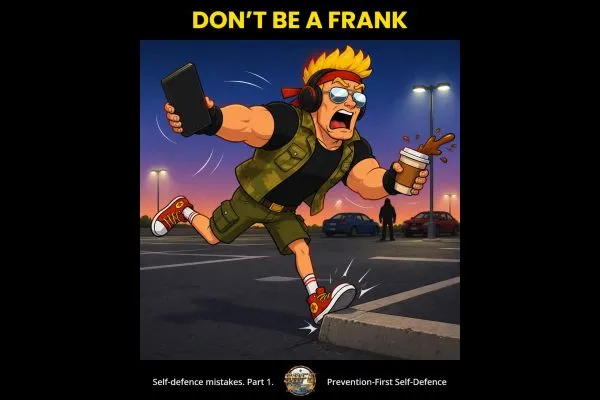
It’s dusk. Frank is walking to his car. Headphones on. Phone in one hand. Coffee in the other. Sunglasses still on, even though the sun is almost gone.
Then he trips on the curb.
He didn’t see the curb. He didn’t see the person standing by the cars either.
Frank isn’t careless. He’s normal. And he just checked all three boxes an attacker looks for.
Get the free guide, Car Safety Many People Get Wrong.
How does an attacker choose who to target?
At SAFE, we teach three things a predator looks for:
Isolated: a person away from other people. An empty parking lot. A quiet path. A stairwell.
Distracted: a person not paying attention to what’s around them.
Vulnerable: a person who looks like they can’t respond. Hands full. Eyes down. Off balance. Physically limited.
One of these can be enough to get noticed.
Frank has all three.
Isolated: a near-empty lot at dusk.
Distracted: five layers stacked at once.
Vulnerable: both hands full, eyes on his phone, tripping on a curb.
Frank thinks his size keeps him safe. Lots of people think that about Frank too. But size doesn’t count for much if you never see it coming.
The distractions don’t just distract Frank. They make him look vulnerable too. Full hands. Blocked ears. Eyes down.
You can’t always avoid being alone in a parking lot. But you can cut your distraction stack in a few seconds. Do that, and your eyes and ears are free to read what’s around you.
Look at the image again. Did you spot the person by the cars? Frank didn’t.
What is the distraction stack?
A distraction stack is when small distractions pile up.
Each one blocks one sense or fills one hand. One on its own is not a big deal. But stack them, and you’re not really in the parking lot anymore. You’re in your phone, your music, your coffee.
Frank’s stack, one layer at a time
Ears: headphones on. He can’t hear footsteps, voices, or cars.
Eyes: on his phone. He can’t see the parking lot, other people, or cars.
Eyes again: sunglasses at dusk. Even less light. But Frank thinks he looks cool.
Hands: coffee in one, phone in the other. Both hands are busy.
Feet: he didn’t even see the curb.
That’s five layers. Most people carry three or four without noticing.
Your brain has limited attention. And no, you can’t multitask your awareness.
Each distraction takes a chunk of your attention. Stack all five, and there’s almost nothing left for the surrounding environment.
If Frank can’t see a curb, how can he see a person?
Parking lot safety tips: how to drop your stack
You don’t need all of these. Drop one. Then another.
Put your phone away before you walk out the door. Send the text beforehand, or send it from the car with the doors locked.
Take your earbuds out until you’re in the car. You want to hear footsteps, engines, and people.
Take sunglasses off at dusk. Light drops fast.
Keep a hand free. Coffee in one hand is fine. Coffee and phone are a full stack.
Have your keys ready before you reach the car. Not digging in a bag at the door.
From a distance, glance around your car, under it, and between nearby cars.
Trust the “something’s off” feeling. If it doesn’t feel right, go back inside.
Do you need to be on high alert?
No.
You don’t need to scan like you’re in a movie. You don’t need to fear every parking lot.
Be present, with fewer distractions. Keep your eyes up for the 30 seconds it takes to reach your car.
“Prevention is the easiest thing to remember under stress. Because it happens before the harder stress hits.”
Simple habits increase the ability to recall
Frank thinks he’s “always aware.” His overconfidence is the mistake.
Real awareness is a habit you can build without paranoia. Phone away. Earbuds out. Hands-free. Those are things you can actually remember when you’re tired, rushed, or carrying groceries.
“Under stress, you don’t rise to the occasion. You fall to what you can remember.”
SAFE has taught this since 1994. Over 200,000 people in Ontario, Canada, have participated in our SAFE International courses. And we have certified instructors in 12+ countries. The pattern we see: simple habits are recalled when it counts.
Quick check: count your distractions
Isolated? Distracted? Vulnerable? Count how many apply.
Then, on your next walk to the car, check:
Are your ears covered?
Are you staring at a screen?
Do you wear sunglasses after dark? DON’T BE A FRANK
Are both your hands full?
Are your car keys still in your bag?
Two or more? Drop one.
Want more habits like this? Get the free guide, Car Safety Many People Get Wrong.
For instructors: self-defence instructor training that sticks
Most classes teach awareness as one big idea: “Be aware of your surroundings.”
Students nod. Then they forget it. “Be aware” is too vague to recall.
The distraction stack breaks awareness into parts students can count. One sense at a time. Ears, eyes, hands, feet. It turns the “distracted” part of victim selection into something students can see and fix.
Test this in your next class:
Have a student walk across the room carrying a full stack: earbuds, phone, cup, bag.
Have a partner quietly walk behind them, use their voice, and quickly interrupt their path.
Ask the student what they noticed and how they felt. Then drop one distraction and run it again.
Remember, the distracted student knows something is going to happen; in reality, most are totally oblivious to their surroundings when their senses are occupied.
This is how SAFE teaches: prevention first, built for recall. If you want a full system you can add to what you already teach, see our self-defence instructor certification.
FAQ
What are the most important parking lot safety tips?
Put your phone away, take out your earbuds, keep a hand free, and have your keys ready before you reach the car. Most importantly, trust your gut if something feels off.
How do attackers choose a target?
At SAFE, we teach three things: isolation, distraction, and vulnerability. Distraction is the easiest one to fix, and fixing it also makes you look less vulnerable.
Is it safe to walk to your car with headphones on?
It’s one more layer in your stack. Headphones plus a phone plus full hands is how people stop noticing what’s around them. Take them out until you’re in the car.
How do I become a self-defence instructor who teaches prevention?
Look for a programme that teaches prevention and conflict skills first, with physical skills as the last resort. SAFE Certification is built that way, and it adds to what you already teach.
Prevention-First Self-Defence
Simple to Remember. Built for Stress.


