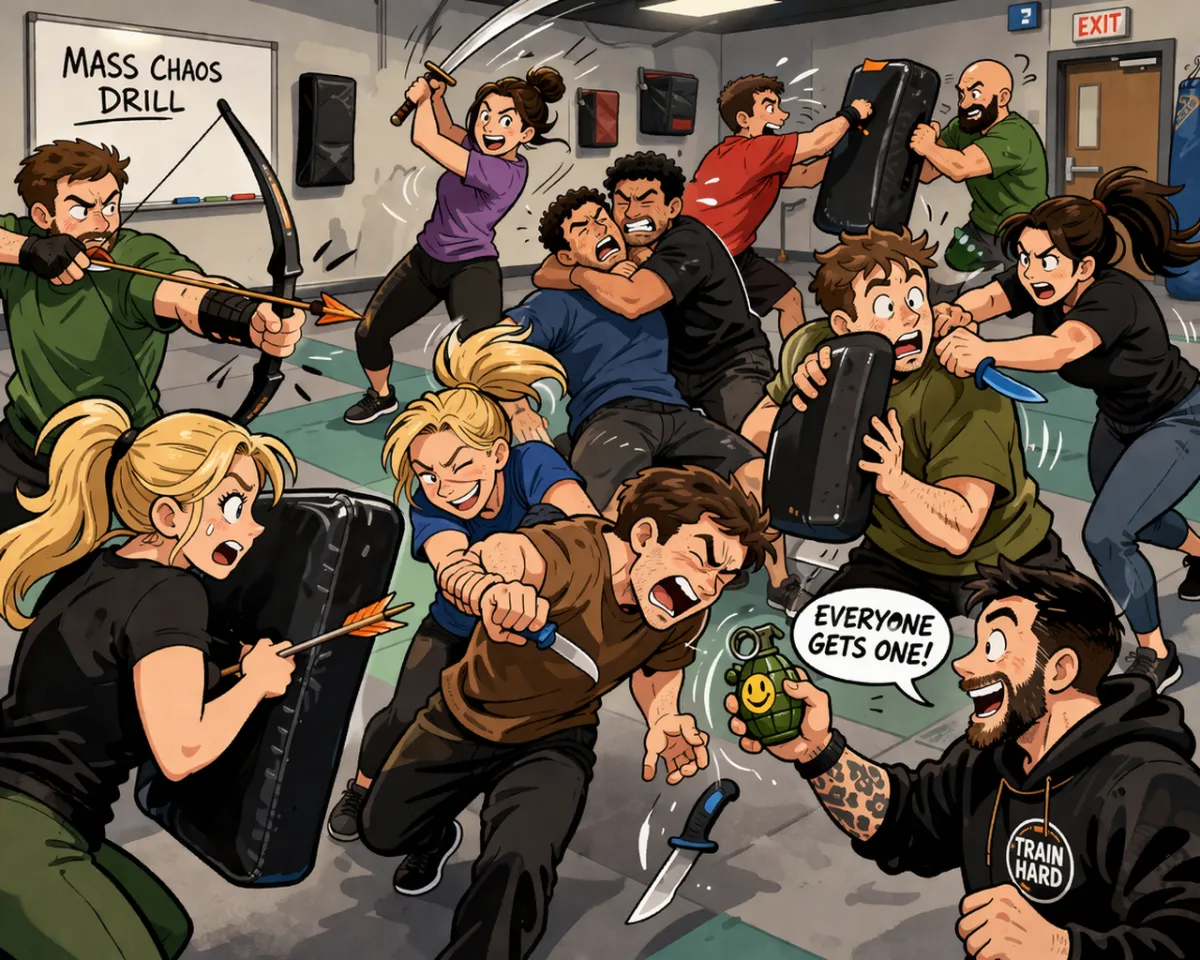
Are Mass Chaos Self-Defence Drills Effective — Or Do They Create Confusion?
Mass chaos drills are common in self-defence training
Many are designed to simulate stress and unpredictability
But when run poorly, they create confusion instead of usable skill
This article breaks down what goes wrong and how to fix it
What Are Mass Chaos Self-Defence Drills?
Mass chaos self-defence drills are group training exercises where multiple students move around at the same time and randomly engage one another in simulated attacks. Some may be holding striking shields, some may have training knives, and others may have no equipment at all. The idea is usually to create movement, unpredictability, stress, and fast decision-making.
On paper, that sounds useful. But in practice, these drills often turn into a scattered mess of half-started punches, loose chokes, weak bear hugs, rushed knife attacks, and defenders already looking for the next threat before dealing with the one in front of them.
When that happens, the drill may look intense, but it is often reinforcing confusion more than skill.
Why Chaos Drills Feel Effective (But Often Aren’t)
These drills can feel productive because they look busy, fast, and intense. But intensity alone does not mean people are learning useful skills.
intensity ≠ skill
activity ≠ learning
confusion ≠ realism
adrenaline ≠ improvement
Common Mistakes in Chaos Drills
When these drills are poorly run, the same problems show up again and again.
no commitment
switching targets too fast
defenders not finishing
no structure or rules
weak or unrealistic attacks
students looking for the next threat too early
What These Drills Actually Teach (The Problem)
Poorly run chaos drills often teach habits that work against good judgment under pressure.
scanning instead of effective decision-making
incomplete responses
shallow reactions
poor threat prioritisation
breaking focus too early
Under stress, you don’t rise to the occasion — you fall to what you can remember.
How to Run Chaos Drills Properly
If you want this kind of drill to have real value, it needs structure. Chaos by itself does not build skill. The drill has to train students to recognize a problem, commit to a response, and stay with it long enough to learn something useful.
commit to one attack
The attacker should begin with clear intent and stay with that attack long enough for the defender to actually respond.finish the interaction
The defender should not be scanning for the next threat before dealing with the current one. Finish what is in front of you first.controlled entry and exit
Students need to know when to engage, when to disengage, and what signals or boundaries control that transition.clear roles
Everyone should understand their job in the drill. Who is attacking, who is defending, what level of resistance is expected, and what the goal is.instructor pauses and corrections
If the drill starts falling apart, stop it. Correct it. Reset expectations. The value often comes more from the correction than from the chaos itself.
A good chaos drill does not just create movement. It creates decision-making you can actually recall under stress.
When Chaos Drills Do Have Value
Chaos drills can be useful when they are structured properly and tied to a clear objective. The goal is not to create random movement, but to expose students to decision-making under pressure in a controlled way.
When done well, self-defence instructors can help develop:
awareness under pressure
Students learn to recognise what is happening around them without becoming overwhelmed.threat prioritisation
Deciding who or what to deal with first instead of reacting randomly.decision-making speed
Making simple, effective choices instead of freezing or overthinking.verbal and boundary setting
Practising communication while managing distance and intent.emotional control
Staying functional when things feel fast, noisy, and unpredictable.transition between phases
Moving from awareness → verbal → physical when necessary.Chaos has value only when it is controlled enough to teach something clear.
Frequently Asked Questions About Chaos Drills in Self-Defence
Are chaos drills effective for self-defence training?
Chaos drills can be effective, but only if they are structured properly. Without clear roles, commitment, and control, they often create confusion instead of useful skill development.
What is the purpose of chaos drills?
The purpose is to expose students to movement, unpredictability, and decision-making under pressure. The goal is not chaos itself, but learning how to respond effectively within it.
Why do some self-defence drills fail?
Many drills fail because they lack structure. Common issues include weak attacks, no follow-through, constant switching between targets, and no instructor correction. These habits do not hold up under real pressure.
Do self-defence drills need to be realistic?
They do not need to be perfect, but they need to be honest. If the attack, response, or timing is unrealistic, the training can build habits that fail when stress increases.
What makes a self-defence drill effective under stress?
Simple, clear actions that can be repeated and remembered. Drills should focus on commitment, finishing the interaction, and making decisions that hold up under pressure.
Can beginners benefit from chaos drills?
Yes, but only when the drill is scaled properly. Beginners need structure first. Without it, chaos drills can overwhelm them and reinforce poor habits.
If a drill creates confusion faster than recall, it is training the wrong thing.
Under stress, you don’t rise to the occasion — you fall to what you can remember.
If you teach self-defence, build training people can actually recall when it matters.
Keep SAFE!
Chris Roberts
www.safeinternational.biz


