What Ed Kemper Teaches Self-Defence Instructors About Predator Trust Tactics
Good self-defence instructor training isn't about scare tactics.
It's about sharing real cases and teaching simple decisions students can remember.
Ed Kemper is one of the clearest examples.
Despite his intimidating size, he didn't overpower most of his victims to get them in his car.
He made himself look safe.
The safety rule he used against them
In the early 1970s, students near Santa Cruz, California, received a tip.
Only accept rides from cars with a university parking sticker.
It made sense. The sticker meant the driver was part of campus.
Kemper's mother worked at the university. He had the sticker.
The rule meant to protect students helped him.
His methods
Borrowed credibility. The sticker made him look like he belonged on campus.
Practised calm. At 6'9", he knew his size could scare people, so he played the polite, soft-spoken "gentle giant." He gave rides to many hitchhikers without harming them. He was rehearsing the "safe driver" act.
Casual questions. Friendly chat about plans and who was expecting them.
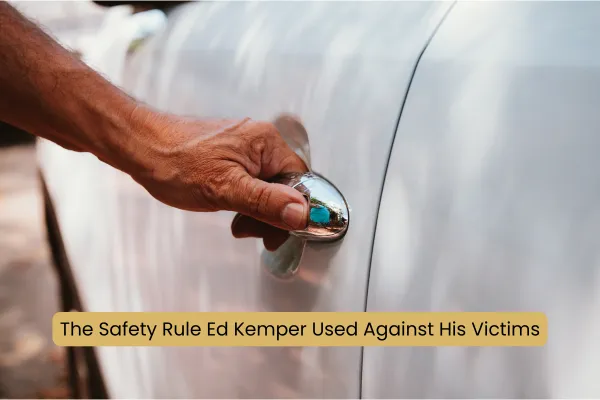
The door "help." He reportedly reached across, claiming the door wasn't shut, and jammed the lock.
Isolation. He changed the route to remote roads.
Why it worked
People trust signals like stickers, logos and uniforms.
People trust calm and politeness.
People don't want to seem rude, so they answer questions and accept "help."
Hitchhiking was common at the time. It felt normal.
None of this is a victim mistake. These are normal human instincts. He used them.
He fooled the experts too
At 15, Kemper killed his grandparents.
He was sent to a state psychiatric hospital.
While there, he worked as an assistant to his psychologist. He saw the tests. He learned the "right" answers.
He was released at 21.
Later, psychiatrists reviewed him again and said he was no longer a danger. He was killing people at the time.
FBI agent John Douglas, who interviewed him years later, described him as smart and easy to talk to.
What this means for your students
If trained experts got fooled, your students can be too. So change the question.
Not: "Does he seem like a good guy?"
Instead: "Is he saying or doing things that make me uncomfortable?"
And notice it early. The earlier you act, the more options you have.
Early signals:
He pushes back after you say no, or ignores it.
He asks too many personal questions. Who's expecting you? Are you alone?
He's in a hurry for you to decide.
He offers help you didn't ask for.
With Kemper, the best moment to act was before getting in the car. Once he reached across the door, the options were already riskier.
When something feels off, that feeling is your friend. It's giving you important information. Act on it with a decision you've already made:
If it feels off, I don't get in.
If I do get in, I call someone before we move.
If he changes the route, I speak up, call someone, and get out at the first safe stop.
You don't have to be rude. Be clear.
Kemper counted on people going along with things to avoid an awkward moment.
The answer isn't to be rude. Rude can turn into a confrontation.
The answer is confidence.
Short. "No thanks."
Calm. No arguing.
No explaining. Explaining opens the door to more pushing.
And if he keeps pushing, attract attention. Speak up. Move toward people. Make it public.
People with bad intentions want isolation, so avoid it.
"But most attacks come from people you know."
In Canada, most sexual assaults are committed by someone the victim knows. (Statistics Canada, 2025)
So why study a stranger like Kemper?
Because the playbook is the same. Only the speed changes.
And Kemper didn't only target strangers. His first and last victims were family.
Same Playbook Over Longer Time
Kemper did this in about 20 minutes.
Someone you know may do it over months.
Look safe | Campus sticker | Good reputation, friends vouch |
Charm | Calm, polite chat | Lots of attention, moves fast |
Gather info | "Who's expecting you?" | Learns your friends and routines |
Test a boundary | Reaches across "to help" | Checks your phone, "I'll handle it" |
Isolate | Drives to remote roads | Cuts you off from friends |
Control | Jammed door (reported) | Controls money, phone, car |
The lesson: Watch the pattern, not the person.
What should self-defence instructors teach?
Under stress, you don't rise to the occasion. You fall to what you can remember.
So keep it to 4 decisions. They work whether the person is a stranger or someone your students know.
1. One signal is not enough
A sticker, uniform or good reputation can be borrowed or faked. Talk with your students about a time they trusted someone because of a logo or name tag, and what a quick second check would have looked like. For rideshares or taxis, that means matching the plate and driver in the app before getting in.
With people they know, "everyone says he's great" is a signal too. What has he actually done?
2. Forced help
People who want control often start small. They "help" with things you can do yourself, like reaching across to fix your door.
Ask your students when someone last did this to them and why they let it happen. A calm "I've got it" is enough. With people they know, it might look like checking your phone or handling your money.
3. What is behind the question
Friendly questions can be fishing. "Who's expecting you? Are you alone?"
Give students one short answer they can use: "My friend's tracking my location." If someone keeps pushing, a clear "No thanks" and walking toward other people usually says the rest.
4. Wrong direction, act early
The best time to act is before the car moves. Call someone while he can hear you, and share your location.
If the route changes, speak up right away and call someone on speaker. The goal is to avoid being taken to a second location. If he won't stop, watch for the car slowing at lights or stop signs. That's the window to get out and get to people.
With someone they know, being slowly pulled away from friends and family is a wrong turn too.
Turn these into scenarios
Each of these makes a strong scenario for class. A couple of chairs set up as car seats and a role-player is all you need.
The SAFE Scenario Trainer shows you how to build and run scenarios like these, with role-player guides, escalation levels and worksheets.
Get the SAFE Scenario Trainer
A few teaching notes
Keep the blame off the victims. Kemper used instincts we all have.
Leave out the graphic details. They make the room tense and don't help anyone remember what to do.
And keep bringing it back to people your students know. That's where most of them will run into this.
Want a system built this way?
SAFE teaches instructors to turn real cases into simple, recall-first lessons that work for regular people.
That's the core of SAFE Self-Defence Instructor Certification.
FAQ
How do I teach real crime cases without scaring students?
Lead with the lesson, not the crime. Skip graphic detail. End every case with a few simple decisions, discussions and drills.
Why not teach students to spot dangerous people?
Kemper fooled psychiatrists. Judging character isn't reliable. Noticing behaviour, trusting that uneasy feeling, and having a first move ready is easier to recall under stress.
Is stranger danger the main risk?
No. Most sexual assaults in Canada are committed by someone the victim knows. That's why SAFE teaches patterns, not strangers.
What's the most important lesson from the Kemper case?
One safety signal is not enough. Predators study safety rules too.
Changing & Saving Lives Since 1994.


